
What is Georgian food?
Georgian food is the cuisine of the country of Georgia in the Caucasus, built on bread and cheese, walnuts, fresh herbs, grilled meat and slow-cooked stews. It has a character of its own while sharing traits with the cooking of the Caucasus, the Middle East and Eastern Europe.
Eating and drinking are central to Georgian culture. The traditional feast is the supra, led by a toastmaster, where dishes are shared across the table.
What is the national dish of Georgia?
The dish most often given as Georgia’s national dish is khachapuri (ხაჭაპური), a bread filled with cheese. The khachapuri tradition was added to Georgia’s national list of intangible cultural heritage on 22 January 2019. Khinkali, the soup dumplings of the eastern mountains, is the other dish to know first.
Khachapuri is less one dish than a family of them. Imeruli, from Imereti, is a round bread filled with salted white cheese; Adjaruli, from Adjara, is boat-shaped, with butter and an egg yolk in the middle; Megruli, from Samegrelo, adds more cheese on top.
What food is Georgia famous for?
Georgia is famous for its cheese breads, its dumplings, its walnut sauces and its grilled meat. Ten dishes carry much of that reputation; the table says what each is, where it comes from, and whether it is vegan as usually made.
| Dish | What it is | Where it comes from | Vegan? |
|---|---|---|---|
| Khachapuri | Bread filled with cheese, in many regional shapes | Imereti, Adjara, Samegrelo and other regions, each with its own | No |
| Khinkali | Dumplings with a knot on top, holding meat and broth | Pshavi and Khevsureti, in the eastern mountains | Usually not; mushroom, potato and cheese fillings exist |
| Mtsvadi | Meat grilled on skewers over embers | Kakheti above all | No |
| Pkhali | Chopped vegetables such as spinach or beetroot, mixed with walnut paste, garlic and herbs | Imereti, among others | Yes |
| Lobio | Beans cooked with coriander, walnuts, garlic and onion, hot or cold | Racha, among others | Yes, in its plain forms |
| Chakapuli | Lamb stewed with tarragon and other fresh herbs | Kakheti | No |
| Satsivi | Chicken or turkey in a walnut sauce | Guria | No |
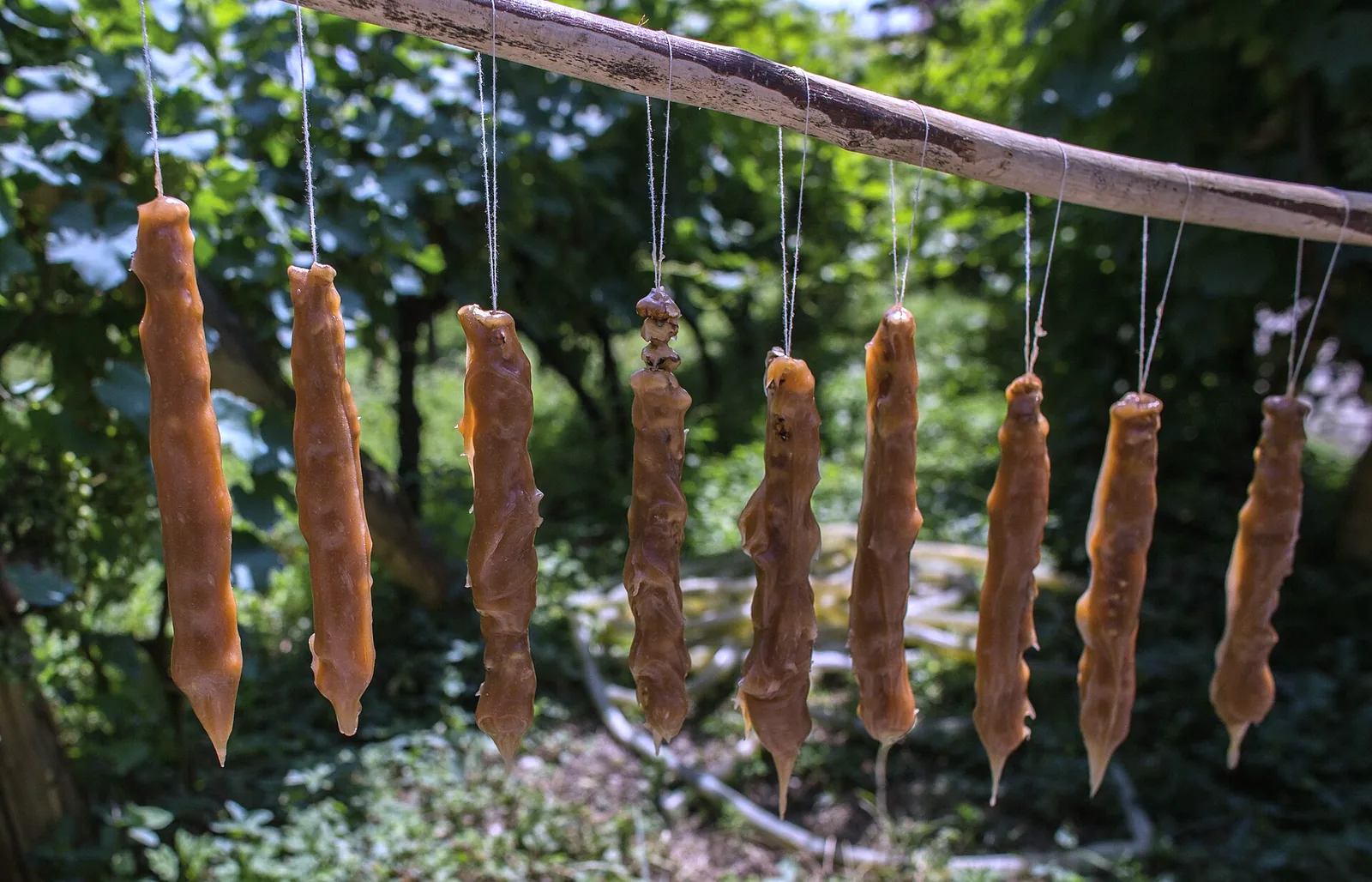
| Churchkhela | Strings of nuts dipped in thickened grape must | Kakheti | Yes |
| Elarji | Cornmeal porridge with sulguni cheese kneaded in | Samegrelo | No |
| Kubdari | Bread filled with spiced meat | Svaneti | No |
Georgian food by course
Georgian food falls into a handful of groups, and a Georgian menu is built from them: breads, dumplings and grilled meat, stews and soups, vegetable and walnut dishes, cheese, sweets, sauces and drinks.
Breads and khachapuri
Georgian breads run from khachapuri, filled with cheese, to mchadi, a cornbread of Imereti and Guria. Lobiani is the bean-filled version of khachapuri, and kubdari the meat-filled one from Svaneti.
Dumplings and grilled meat
Khinkali and mtsvadi are the classic meat dishes. Khinkali are dumplings with a knot on top; mtsvadi are pieces of pork or other meat grilled on skewers over embers.
Stews and soups
Chakapuli, lamb with tarragon, and chashushuli, meat fried and then stewed with tomatoes, are two classic stews. Kharcho, beef cooked with walnuts and spices, is served as a soup or, in Samegrelo, as a thick stew.
Vegetables and walnut dishes
Walnuts run through the whole cuisine. Pkhali mixes chopped vegetables with walnut paste, and satsivi uses a walnut sauce for poultry.
Cheese
Imeruli, the salted white cheese of Imereti, fills Imeruli khachapuri, the round, closed kind. Sulguni, a stretchy cheese of Samegrelo, goes into elarji and many breads.
Sweets
Churchkhela is a traditional Georgian sweet: nuts threaded on a string and dipped in grape must thickened with flour. It is made at harvest time and eaten through the winter holidays.
Spices and sauces
Khmeli suneli is the dried herb and spice mix behind many stews, and blue fenugreek and ground coriander seed are two more of its spices. Ajika, a chilli paste, and tkemali, a sour plum sauce, are the table sauces.
Drinks: wine, chacha and the rest
Wine is the drink of the Georgian table, and chacha, a strong spirit distilled from the grape skins and pips left after winemaking, is its brandy. At a supra, wine is drunk to toasts.
Georgian food by region
Georgian food changes from region to region, and many dishes carry the name of the place they come from. In the east, food follows the vine: mtsvadi grilled over vine clippings and churchkhela made with thickened grape must are dishes of Kakheti, the country’s main wine region. The high mountains eat differently: kubdari, a bread filled with spiced meat, is the dish of the Svans, and Svan salt, a spiced salt, comes from Svaneti too.
| Region | Signature dishes |
|---|---|
| Adjara | Adjaruli khachapuri, borano (cheese fried in butter) |
| Imereti | Imeruli khachapuri, mchadi, pkhali |
| Samegrelo | Megruli khachapuri, elarji, gebzhalia (cheese rolls with mint), kharcho, ajika |
| Guria | Satsivi, kupati (pork sausage) |
| Svaneti | Kubdari, Svan salt |
| Racha | Lobiani (bean bread) with lori ham, shkmeruli (chicken in garlic and cream) |
| Kakheti | Mtsvadi, chakapuli, churchkhela |
| Pshavi, Khevsureti and Tusheti | Khinkali, gordila (boiled dough), dried salted meat |
Why so much Georgian food is vegan
Much Georgian food is vegan because the Georgian Orthodox Church asks the faithful to fast, and fasting means no meat, dairy or eggs. The main fast, Great Lent, begins seven weeks before Orthodox Easter and, with Holy Week, runs up to Easter itself.
The result is a whole repertoire of dishes that need no animal products: pkhali, lobio, walnut-dressed vegetables and churchkhela among them. In Lent many Georgians switch to vegan versions of everyday food and restaurants offer fasting dishes, which makes it a good time of year to eat vegan in Georgia.
Is Georgian food like Russian food?
No. Georgian food is a cuisine of its own, built on walnut sauces, fresh herbs, spice blends such as khmeli suneli and cheese breads. It shares traits with the cooking of the Caucasus, the Middle East and Eastern Europe, and it is well known in Russia, but it is not Russian cooking.
Is Georgian food spicy?
Mostly no: Georgian food is aromatic rather than hot, seasoned with herbs, garlic, walnuts and spice blends. The exception is Samegrelo in the west, whose food is known for being hot, and ajika, the chilli paste from Samegrelo and Abkhazia that appears on tables across the country.
How to eat in Georgia
To eat the Georgian way is to share: dishes are ordered for the whole table, toasts set the pace of a feast, and khinkali have their own way of being eaten.
The supra and the toasts
A supra is a traditional Georgian feast, led by a tamada, the toastmaster. The tamada proposes each toast and speaks about its subject while the guests raise their glasses and wait; a festive supra is called a keipi. The traditions of the supra were added to Georgia’s national list of intangible cultural heritage in 2017.
How to eat khinkali
Khinkali are eaten with the hands, not a knife and fork, because cutting one spills the broth inside. Hold it by the knot, bite a small hole, drink the broth, then eat the rest. The knot at the top is tough and is left on the plate, which is also how a table counts how many it has eaten. Folding that knot by hand takes practice, and it is one thing Georgian cooking classes set out to teach.
Ordering and tipping
Order several dishes for the table rather than one each. Some restaurants, especially in Tbilisi, add a service charge to the bill, so check for a “service” line before leaving anything extra.
Where to eat Georgian food in Georgia
Khachapuri and khinkali are on menus across the country, but to eat a regional dish in its own setting, go to the region it comes from: Adjaruli khachapuri in Adjara, mtsvadi in Kakheti, kubdari in Svaneti, khinkali in the mountains north of Tbilisi. In towns and cities, look for a sakhinkle, a restaurant that specialises in khinkali.
In the capital, a guided walk through markets and kitchens lets you taste many dishes in one afternoon, which is what Tbilisi food tours are for. Food is only part of a Tbilisi visit: the sulphur baths, the old town and Narikala fortress are among the things to do in Tbilisi too.
Eat it with a local: food experiences you can book
Food experiences in Georgia come in a few kinds: guided food walks in Tbilisi, cooking classes in a family or school kitchen, and supra dinners with a host. Our picks are on the shortlists of Tbilisi food tours and Georgian cooking classes; for a week of wine and food, start below.
A wine and food tour of Georgia
Three multi-day wine and food tours of Georgia compared on price, nights, cellars, meals and when each one runs.

Can you cook Georgian food at home?
Yes. Many dishes need only vegetables or beans, walnuts, garlic and fresh herbs: pkhali and lobio are two of them. Khachapuri depends on a fresh, salty white cheese such as imeruli, so the cheese is the part to find first.
Questions people ask about Georgian food
Is Georgian food vegetarian-friendly?
Yes. Fasting in the Georgian Orthodox Church has given the cuisine many dishes with no meat, dairy or eggs, such as pkhali, lobio and churchkhela, and many more are vegetarian.
What is a supra?
A supra is a traditional Georgian feast, where many dishes are shared and a toastmaster called the tamada leads the toasts.
What is khinkali?
Khinkali are Georgian dumplings from the eastern mountains, filled with meat and broth, and eaten by hand.
What do Georgians drink with food?
Wine, above all, drunk to toasts at the table. Chacha, a strong grape spirit, is the other traditional drink.